Address
Future Science Park, Nanhu, Hangzhou
Open Hours
Workday: 7AM - 7PM
Holiday: 10AM - 5PM
Address
Future Science Park, Nanhu, Hangzhou
Open Hours
Workday: 7AM - 7PM
Holiday: 10AM - 5PM

Discover the complete guide to Lithium Battery Nigeria, BESS, and Solar Storage Lagos. Learn how lithium batteries solve Nigeria’s unstable national grid, high fuel costs, and meet surging solar storage demand. Expert insights for homes & businesses.
 Byeditor
Imagine running a small business in Lagos: your generator roars to life for the third time today, burning expensive petrol that’s only gotten costlier since Nigeria’s fuel subsidy removal. Or you’re a family in Kano, relying on a lead-acid battery that dies after just two years, leaving you in the dark during yet another national grid collapse. For millions of Nigerians—whether homeowners, SMEs, or industrial operators—this is not a hypothetical; it’s daily life. Nigeria’s energy landscape is defined by three harsh realities: an unstable national grid prone to frequent collapses, soaring fuel prices that drain budgets, and a surge in demand for solar storage solutions as people seek independence from unreliable power sources.
The National Grid of Nigeria has become synonymous with unreliability. In 2024 alone, the grid collapsed nine times by November, with power generation dropping to zero megawatts on multiple occasions, leaving millions without electricity and disrupting businesses, hospitals, and essential services. Vandalism of transmission towers, rising energy demand, and strained infrastructure have intensified these issues, making blackouts a regular occurrence across all 22 generation companies (GenCos) nationwide. Over the past decade, Nigeria has witnessed 162 grid collapses, costing the country an estimated $29 billion annually in GDP losses, according to the World Bank. For businesses, even a 10-minute outage can mean wasted raw materials, idle labor, and lost revenue—costs that add up quickly in a challenging economic environment.
To make matters worse, Nigeria’s removal of fuel subsidies has sent petrol prices soaring by more than 100%, from N162 per liter to N340 per liter, placing an enormous burden on households and businesses that rely on diesel or petrol generators for backup power. Small businesses, in particular, are struggling to cope with higher operational costs, with many facing reduced profit margins or even closure as fuel expenses eat into their budgets. This perfect storm of grid instability and high fuel costs has led to a massive surge in demand for reliable, cost-effective energy storage solutions—and lithium batteries have emerged as the clear answer.
So, what exactly is a lithium battery, and why is it replacing traditional lead-acid batteries as Nigeria’s preferred backup power solution? A lithium battery is a rechargeable energy storage device that uses lithium ions to store and release electrical energy. Unlike lead-acid batteries, which rely on heavy, toxic lead and sulfuric acid, lithium batteries are lighter, more efficient, and far more durable—making them ideal for Nigeria’s harsh climate and energy challenges. As the country pushes toward 30% renewable energy by 2030, lithium batteries (and their integration into BESSBESS (Battery Energy Storage System) is a sophisticated technology that captures, or Battery Energy Storage Systems) have become the backbone of stable, independent power solutions for homes and businesses alike, aligning with global standards for battery energy storage systems (BESS).
This guide is designed specifically for Nigerians—whether you’re a homeowner in Ibadan, a factory manager in Port Harcourt, or an SME owner in Abuja. We’ll break down the science behind lithium batteries in simple terms, highlight their unique advantages for Nigeria’s environment, debunk common myths, and explain why now is the perfect time to invest in this transformative technology. Our goal is not just to educate, but to show you that lithium batteries are more than a “nice-to-have”—they’re a practical, cost-saving solution that can help you achieve energy independence in a country where reliable power is a luxury.
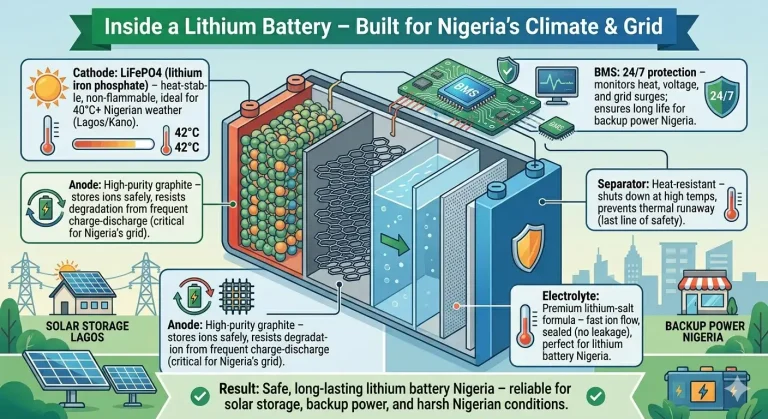
To understand why lithium batteries are superior to lead-acid batteries—especially in Nigeria’s climate—you first need to know what’s inside them. Every lithium battery, whether used for home backup, solar storage, or industrial applications, consists of four core components that work together to store and deliver power. These components determine the battery’s performance, safety, and lifespan—and choosing the right materials (especially for Nigeria’s hot weather) is critical to getting the most out of your investment.
Think of a lithium battery as a well-orchestrated team, where each component has a specific role to play. Here’s a breakdown of the four key parts, explained in simple terms:
In addition to these four core components, lithium batteries also include current collectors (aluminum for the cathode, copper for the anode) to conduct electrons, binders to hold the electrode materials together, and a protective casing to shield the internal components from moisture, dust, and impact. For rechargeable lithium batteries (the type used in solar storage and backup power), a Battery Management System (BMS)—often called the “brain” of the battery—is also included to monitor and protect the battery.
Not all lithium batteries are the same—and for Nigeria’s hot, harsh climate, one type stands out above the rest: LiFePO4 (lithium iron phosphate). LiFePO4 is a specific type of lithium battery that uses iron phosphate as the cathode material, and it offers unique advantages that make it ideal for Nigerian homes and businesses. Let’s break down why LiFePO4 is the best choice for Nigeria, compared to other lithium chemistries like LiCoO₂ or NMC:
For example, a LiFePO4 battery used in a Lagos home with a solar system can withstand the city’s hot temperatures without degrading, last for over a decade, and provide reliable power during extended grid outages. This combination of safety, durability, and performance makes LiFePO4 the clear choice for Nigeria’s energy needs—whether you’re looking for a small backup battery for your home or a large BESSBESS (Battery Energy Storage System) is a sophisticated technology that captures for your business.
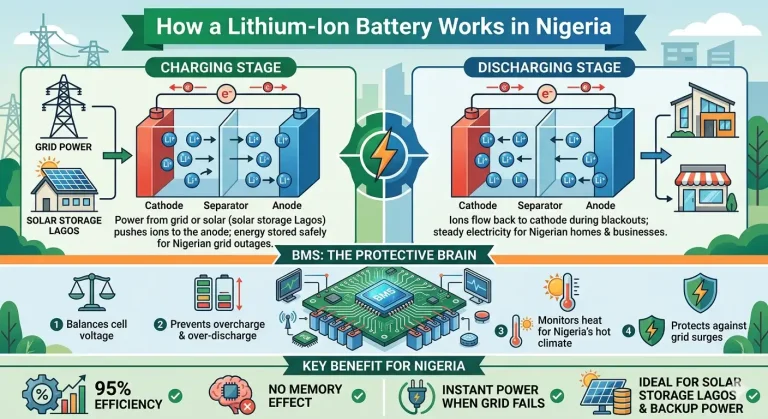
You don’t need a degree in chemistry to understand how a lithium battery works. At its core, a lithium battery is a simple system that stores energy by moving lithium ions between two electrodes—and releases that energy when those ions move back. To make it even easier, we’ll use a simple analogy: shuttle buses (lithium ions) moving between two stations (cathode and anode).
Imagine the cathode and anode as two bus stations, and lithium ions as shuttle buses that carry energy. Here’s how the cycle works, step by step:
This cycle repeats over and over, with the lithium ions moving back and forth between the cathode and anode. The key advantage of lithium batteries is that this process is highly efficient—up to 95% of the energy stored is converted into usable power, compared to just 70–80% for lead-acid batteries. This efficiency means you get more power from every charge, which is critical for Nigeria, where charging opportunities (via grid or solar) may be limited.
Another important thing to note is that lithium batteries do not suffer from the “memory effect” that plagues lead-acid batteries. The memory effect is when a battery “forgets” its full capacity if it’s not fully discharged before recharging. With lithium batteries, you can charge them at any time—even if they’re only partially discharged—without reducing their lifespan or capacity. This flexibility is perfect for Nigeria’s unpredictable grid, where you may need to charge your battery whenever power is available.
When shopping for a lithium battery in Nigeria, you’ll often see two key terms: capacity (Ah/kWh) and discharge rate (C-rate). These terms are critical to understanding how much power the battery can provide and how quickly it can deliver it—and choosing the right values for your needs will ensure you get reliable power when you need it most.
Let’s break down each term in simple terms, tailored to Nigeria’s use cases:
To put this into perspective: If you have a 10kWh LiFePO4 battery with a 1C discharge rate, it can deliver 10kW of power for 1 hour, or 5kW for 2 hours. This is more than enough to power a home with essential appliances during a grid outage. If you have a lead-acid battery of the same capacity, it would only be able to deliver 50% of its capacity (due to lower DoD) and would degrade much faster if discharged at the same rate.
Lithium batteries are not just a “better” option than lead-acid batteries—they’re a game-changer for Nigeria’s energy landscape. They address the country’s most pressing energy challenges: grid instability, high fuel costs, and the need for reliable backup power. Below are the four key advantages that make lithium batteries the perfect choice for Nigerian homes and businesses, with a focus on how they solve local challenges.
The cycle life of a battery is the number of times it can be charged and discharged before its capacity drops to 80% of its original value. This is one of the biggest differences between lithium batteries and lead-acid batteries—and it’s a difference that directly impacts your long-term costs.
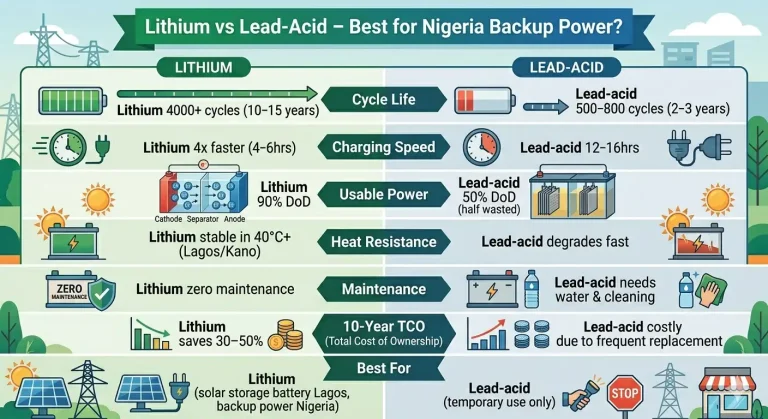
Lead-acid batteries have a typical cycle life of 500–800 cycles (at 50% DoD). In Nigeria’s environment, where grid outages are frequent and batteries are charged and discharged regularly, a lead-acid battery will last just 2–3 years before it needs to be replaced. This means you’ll be spending money on new batteries every few years, which adds up over time.
Lithium batteries, on the other hand, have a cycle life of 4000+ cycles (at 80–90% DoD). For LiFePO4 batteries, this number can be even higher—up to 6,000 cycles with proper maintenance. In practical terms, this means a lithium battery will last 10–15 years in Nigeria’s conditions—5 times longer than a lead-acid battery. This longevity translates to significant cost savings over time, even though lithium batteries have a higher upfront cost.
For example, A lead-acid battery costs N150,000 and lasts 3 years. Over 15 years, you’ll spend N750,000 (5 batteries × N150,000). A lithium battery costs N450,000 and lasts 15 years. Over the same period, you’ll spend N450,000—saving N300,000. For businesses, these savings are even more significant—especially for SMEs that rely on backup power to stay operational.
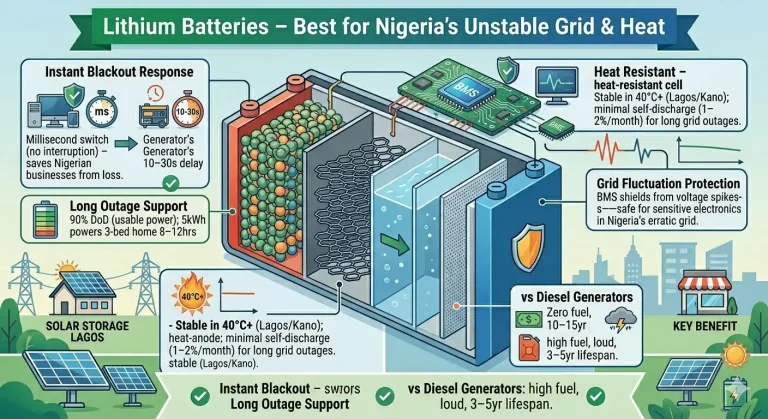
Nigeria’s climate is one of the harshest in Africa, with temperatures often exceeding 35°C (95°F) in major cities like Lagos, Kano, and Abuja. This extreme heat is brutal on batteries—lead-acid batteries degrade quickly in high temperatures, losing capacity and lifespan. Lithium batteries (especially LiFePO4) are designed to withstand these conditions, making them far more reliable in Nigeria’s weather.
Here’s why lithium batteries are better suited to Nigeria’s heat:
A real-world example: A solar-powered home in Lagos using a LiFePO4 battery reported that the battery retained 90% of its capacity after 5 years of use, even though it was stored in an unconditioned garage where temperatures often reached 40°C. A neighboring home using a lead-acid battery had to replace it after just 2 years, as the heat caused it to lose 50% of its capacity.
Depth of Discharge (DoD) is the percentage of a battery’s capacity that can be safely used before it needs to be recharged. This is another critical advantage of lithium batteries—they can be discharged much deeper than lead-acid batteries, giving you more usable power.
Lead-acid batteries can only be safely discharged to 50% of their capacity (50% DoD). If you discharge them beyond this point, you’ll significantly reduce their lifespan and risk permanent damage. This means that a 100Ah lead-acid battery only gives you 50Ah of usable power.
Lithium batteries (especially LiFePO4) can be safely discharged to 90% of their capacity (90% DoD). This means a 100Ah lithium battery gives you 90Ah of usable power—nearly twice as much as a lead-acid battery of the same size. For Nigeria, where grid outages can last for hours or even days, this extra usable power is a game-changer.
Let’s put this into perspective for a typical Nigerian home: A 5kWh lead-acid battery (50% DoD) gives you 2.5kWh of usable power—enough to power a fridge and a few lights for 4–5 hours. A 5kWh lithium battery (90% DoD) gives you 4.5kWh of usable power—enough to power the same appliances for 8–9 hours. This means you’ll have power for twice as long during a grid outage, without needing to recharge.
For businesses, this is even more important. A small restaurant in Abuja using a 20kWh lithium battery can keep its fridge, lights, and POS system running for 12+ hours during a grid outage, while a lead-acid battery of the same size would only last 6 hours. This extra time can mean the difference between losing a day’s revenue and staying operational.
In addition to the three main advantages above, lithium batteries offer several other benefits that make them perfect for Nigeria’s energy needs:
Despite their many advantages, lithium batteries are still surrounded by myths and misconceptions—especially in Nigeria, where lead-acid batteries have been the standard for decades. These myths often prevent people from investing in lithium batteries, even though they’re the better choice. Below, we debunk the two most common myths about lithium batteries, with facts tailored to Nigeria’s context.
Myth: “Lithium batteries are just like lead-acid batteries—they contain acid, which is dangerous and messy.”
Fact: This is completely false. Lithium batteries do not contain any acid—unlike lead-acid batteries, which rely on sulfuric acid to function. The confusion comes from the name “battery,” but the two technologies are fundamentally different.
Lead-acid batteries use a liquid electrolyte made of sulfuric acid and water. This acid is corrosive, toxic, and can leak if the battery is damaged or overheated—posing a safety hazard to humans and the environment. In Nigeria, where many batteries are stored in homes or small businesses, this leakage can cause damage to floors, furniture, and equipment.
Lithium batteries, on the other hand, use a non-acidic electrolyte (usually a lithium-salt solution dissolved in organic solvents) that is sealed inside the battery. There is no liquid acid to leak, and the electrolyte is non-toxic. This makes lithium batteries much safer to use in homes, especially those with children or pets. Additionally, lithium batteries are recyclable, so they have a much smaller environmental footprint than lead-acid batteries.
For Nigerians, this means you don’t have to worry about acid spills, corrosion, or toxic exposure when using a lithium battery. You can install it in any part of your home or business without fear of damage or safety risks.
Myth: “Lithium batteries are dangerous—they can explode or catch fire, especially in Nigeria’s hot climate.”
Fact: While it’s true that some lithium batteries (like those used in cheap electronics) can be dangerous if poorly made, high-quality lithium batteries (especially LiFePO4) are extremely safe—even in Nigeria’s hot climate. The key difference is the Battery Management System (BMS), which acts as the “brain” of the battery.
A BMS is an electronic system that monitors and protects the battery from dangerous conditions, including overcharging, over-discharging, overheating, and short circuits. Here’s how it keeps your lithium battery safe:
LiFePO4 batteries are even safer than other lithium chemistries because of their thermal stability—they do not release oxygen at high temperatures, which significantly reduces the risk of combustion. In fact, LiFePO4 batteries are often used in electric vehicles, medical equipment, and aerospace applications—where safety is critical.
The “exploding lithium battery” myth comes from cheap, low-quality lithium batteries (often used in counterfeit electronics) that do not have a proper BMS. When purchasing a lithium battery in Nigeria, always choose a reputable brand with a high-quality BMS—this will ensure your battery is safe and reliable.
Myth: “Lithium batteries are too expensive—lead-acid batteries are cheaper.”
Fact: While lithium batteries have a higher upfront cost, they are cheaper in the long run when you consider their longer lifespan, lower maintenance costs, and higher efficiency. As we calculated earlier, a lithium battery costs 3 times more upfront than a lead-acid battery but lasts 5 times longer—saving you money over 10–15 years.
Additionally, with Nigeria’s fuel subsidy removal, the cost of running a generator (the main alternative to batteries) has skyrocketed. A lithium battery paired with solar panels can eliminate or reduce your reliance on generators, saving you thousands of naira in fuel costs every year. For example, a small business in Abuja using a 50kWh lithium battery and solar system reduced its generator costs by 60%, with an ROI of just 14 months.
Nigeria’s energy crisis is not going away anytime soon. The national grid will continue to be unstable, fuel prices will remain high, and the demand for reliable energy storage will keep growing. In this environment, lithium batteries are not just a luxury—they’re a necessary investment for anyone who wants to achieve energy independence, reduce costs, and protect their home or business from the impact of blackouts.
To recap, lithium batteries (especially LiFePO4) offer unmatched advantages for Nigeria: 4000+ cycle life, heat resistance, 90% DoD, faster charging, and low maintenance. They solve the country’s most pressing energy challenges, and they’re more cost-effective in the long run than lead-acid batteries or generators.
There has never been a better time to invest in lithium batteries in Nigeria—here’s why:
If you’re ready to invest in a lithium battery, here are the steps you should take to ensure you get the right solution for your needs:
Lithium batteries are transforming Nigeria’s energy landscape. They offer a reliable, cost-effective solution to the country’s grid instability and high fuel costs, and they’re accessible to both homes and businesses. By investing in a lithium battery today, you’re not just buying a backup power solution—you’re investing in energy independence, cost savings, and a more sustainable future for your family or business.
Whether you’re a homeowner in Lagos looking to power your home during blackouts, an SME in Kano trying to reduce generator costs, or an industrial operator in Port Harcourt needing reliable backup power, lithium batteries are the answer. Don’t let myths or upfront costs hold you back—now is the time to make the switch and take control of your energy future.