Address
Future Science Park, Nanhu, Hangzhou
Open Hours
Workday: 7AM - 7PM
Holiday: 10AM - 5PM
Address
Future Science Park, Nanhu, Hangzhou
Open Hours
Workday: 7AM - 7PM
Holiday: 10AM - 5PM

Compare LFP vs NMC batteries for commercial & industrial energy storage. Analyze safety, lifespan, cost, energy density & ideal use cases for optimal procurement.
 Byeditor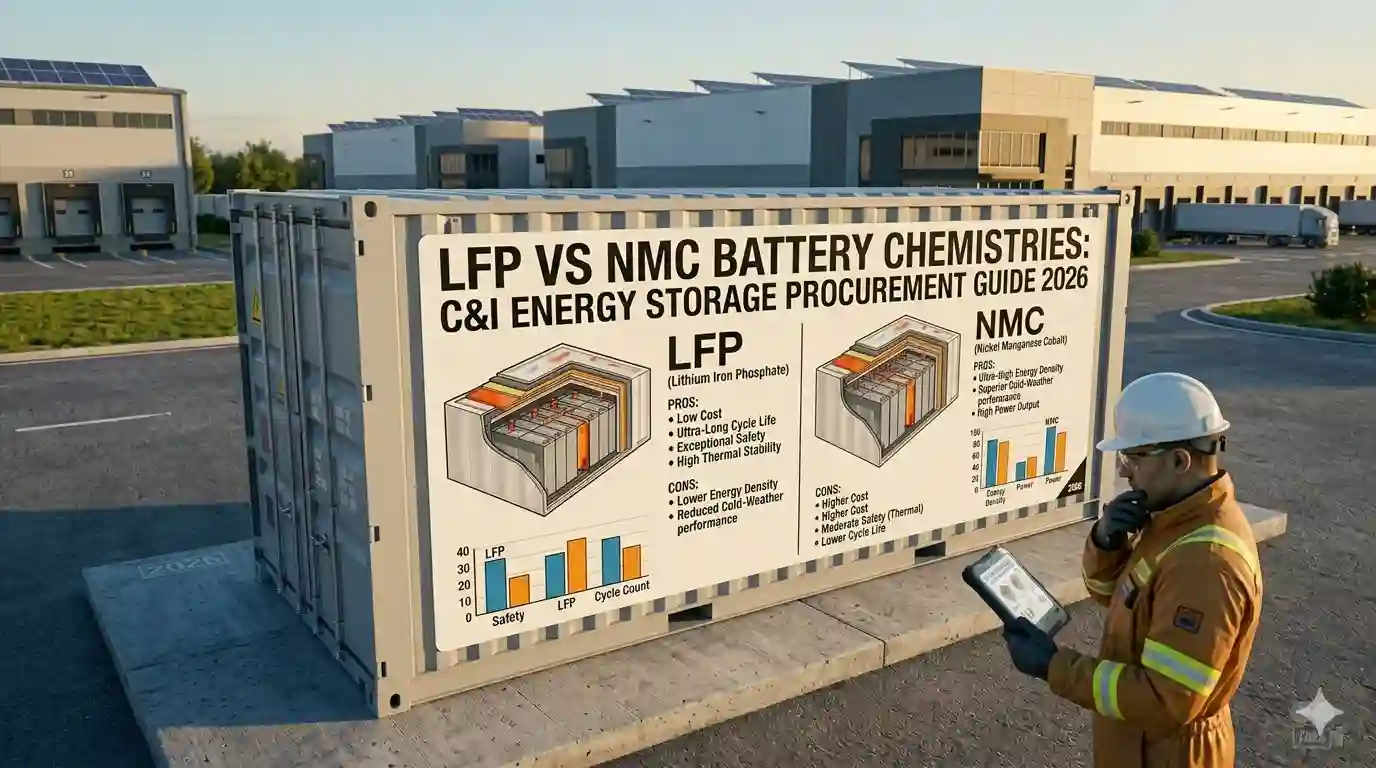
Selecting between LFP (Lithium Iron Phosphate) and NMC (Nickel Manganese Cobalt) is one of the most critical decisions in C&I energy storage procurement. These two chemistries dominate the market but offer starkly different performance profiles, directly impacting your system’s safety, ROI, lifespan, and operational suitability. This guide breaks down their core differences, common pitfalls, and ideal applications to help you choose the right cell technology. For a comprehensive overview of all critical procurement factors, explore our complete guide:
| Parameter | LFP (Lithium Iron Phosphate) | NMC (Nickel Manganese Cobalt) |
|---|---|---|
| Safety & Thermal Stability | Excellent: High thermal runaway threshold, non-flammable phosphate chemistry | Good: Lower thermal stability; higher fire risk, requires robust safety systems |
| Cycle Life | 6,000–10,000 cycles (80% DOD) | 2,000–3,000 cycles (80% DOD) |
| Energy Density | Moderate (160–195 Wh/kg) | High (200–260 Wh/kg) – 20–30% higher than LFP |
| Cost | Low: Abundant raw materials (Fe, P), no cobalt/nickel | High: Dependent on costly cobalt & nickel, volatile pricing |
| Low-Temp Performance | Poor: Capacity drops significantly below -10°C | Good: Stable performance down to -20°C |
| Ideal C&I Use Case | Long-duration (4–8h), industrial, high-safety, cost-sensitive projects | Short-duration (1–2h), space-constrained, cold-climate projects |
We design systems tailored to your operational environment:
LFP vs NMC: 2026 Cost & Performance Analysis for Energy Storage
and
LFP Battery Innovations for Commercial & Industrial Storage.