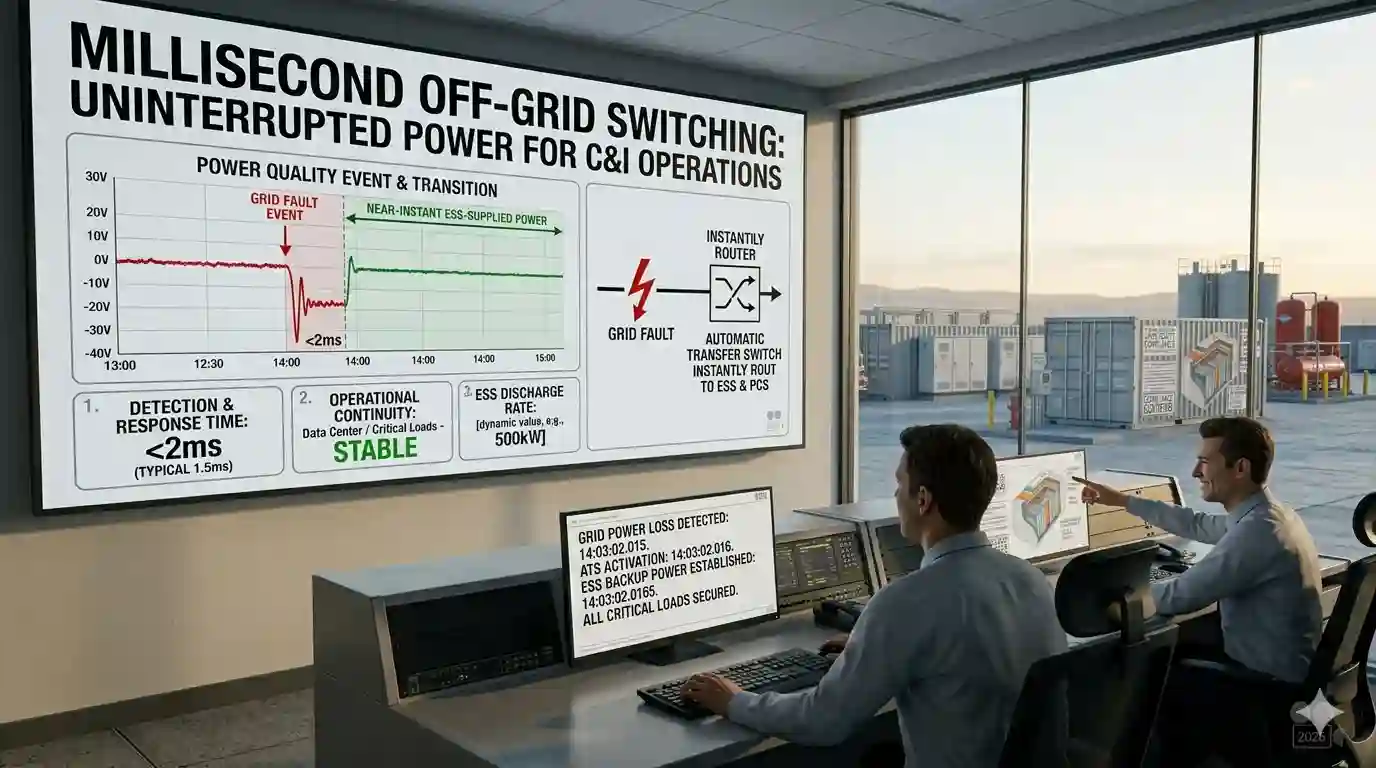
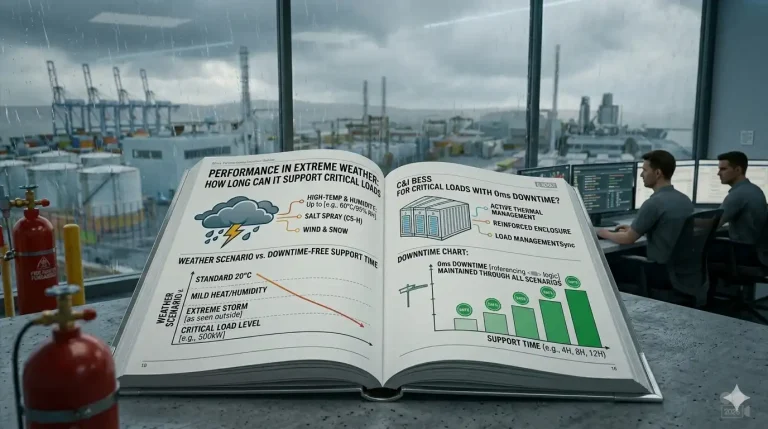
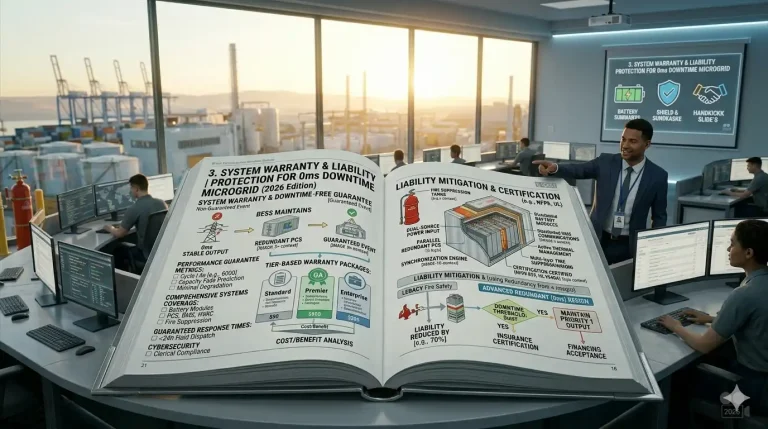
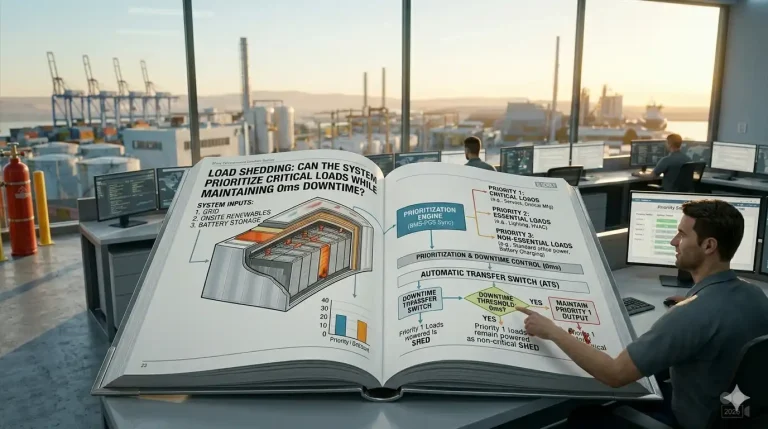
For mission-critical C&I facilities (data centers, manufacturing, hospitals, telecom), millisecond-level seamless off-gridOff-grid solar is a standalone photovoltaic system that operates independently o switching is non-negotiable. Standard systems take 1–15 minutes to switch to island mode, causing costly downtime, equipment damage, and production losses. Modern solutions achieve <20ms (often <10ms) transitions—so fast that loads never detect an outage. This page explains key technologies, pitfalls, and procurement criteria. For complete C&I storage guidance, see our comprehensive guide:
The Ultimate Guide to Avoiding Pitfalls in Commercial & Industrial Energy Storage Procurement: 15 Critical Questions & Solutions (2026 Edition).
Critical Pitfalls in Off-Grid Switching
- Assuming “fast switching” = seamless: Many systems claim “fast” but take >100ms—too slow for sensitive electronics (PLCs, servers, motors).
- Ignoring STS (Static Transfer Switch) quality: Low-grade STS causes arcing, transfer delays, or partial outages; must be ultra-fast (<5ms) solid-state design.
- PCS control mode limitations: Grid-following PCS can’t form a stable off-gridOff-grid solar is a standalone photovoltaic system that operates independently o voltage/frequency; requires grid-forming (grid-support) PCS.
- Inadequate voltage/frequency ride-through: System fails to stabilize microgrid voltage post-switch, leading to load drops.
Core Technologies for <20ms Seamless Switching
- Grid-Forming PCS (Essential)
- Operates in voltage source mode to independently establish stable voltage/frequency (50/60Hz) when the grid fails.
- Contrasts with grid-following PCS, which relies on grid reference and cannot support off-gridOff-grid solar is a standalone photovoltaic system that operates independently o loads alone.
- Ultra-Fast Static Transfer Switch (STS)
- Solid-state (no moving parts): Breaks grid connection in <5ms; redirects power to PCS without interruption.
- Dual-power supply design ensures STS control power never fails.
- High-Speed EMS/BMS Coordination
- Real-time grid monitoring (sampling rate ≥1kHz) detects anomalies before full outage.
- Predictive algorithms trigger pre-emptive PCS mode change, cutting transfer time to <10ms.
- Load & Stability Controls
- Fast-acting voltage/frequency regulation (fluctuations <3% during switch).
- 150–200% overload capacity for motor/transformer inrush currents.
APEX Solution: Zero-Interruption Off-Grid Switching
- APEX RapidSwitch System: Industry-leading ≤10ms seamless transfer for critical C&I loads.
- Grid-Forming PCS: Native grid-forming design with ultra-fast dynamic response.
- Industrial-Grade STS: Solid-state, dual-power, UL-listed switches with <5ms break time.
- Predictive Grid Monitoring: AI-powered EMS detects grid anomalies 50–100ms in advance, enabling pre-emptive switching.
- Transient Stability: Advanced controls maintain voltage/frequency within ±1% during transition, protecting sensitive electronics.
Procurement Checklist: Off-Grid Switching
- Require verified <20ms transfer time (third-party lab reports preferred).
- Confirm PCS supports grid-forming (not just grid-following) mode.
- Specify solid-state STS (not mechanical) with <5ms switching.
- Validate voltage/frequency stability (≤3% deviation) during transition.
- Ensure overload capacity ≥150% for motor/inductive loads.
- For technical benchmarks:
≤15ms Seamless Off-Grid Switching for Industrial Storage
and
Ultra-Fast STS Technology for Zero-Interruption Power.

 Byeditor