Address
Future Science Park, Nanhu, Hangzhou
Open Hours
Workday: 7AM - 7PM
Holiday: 10AM - 5PM
Address
Future Science Park, Nanhu, Hangzhou
Open Hours
Workday: 7AM - 7PM
Holiday: 10AM - 5PM

All-in-One vs. split-type C&I energy storage systems. Compare installation, scalability, maintenance & costs to choose the right integration for your project.
 Byeditor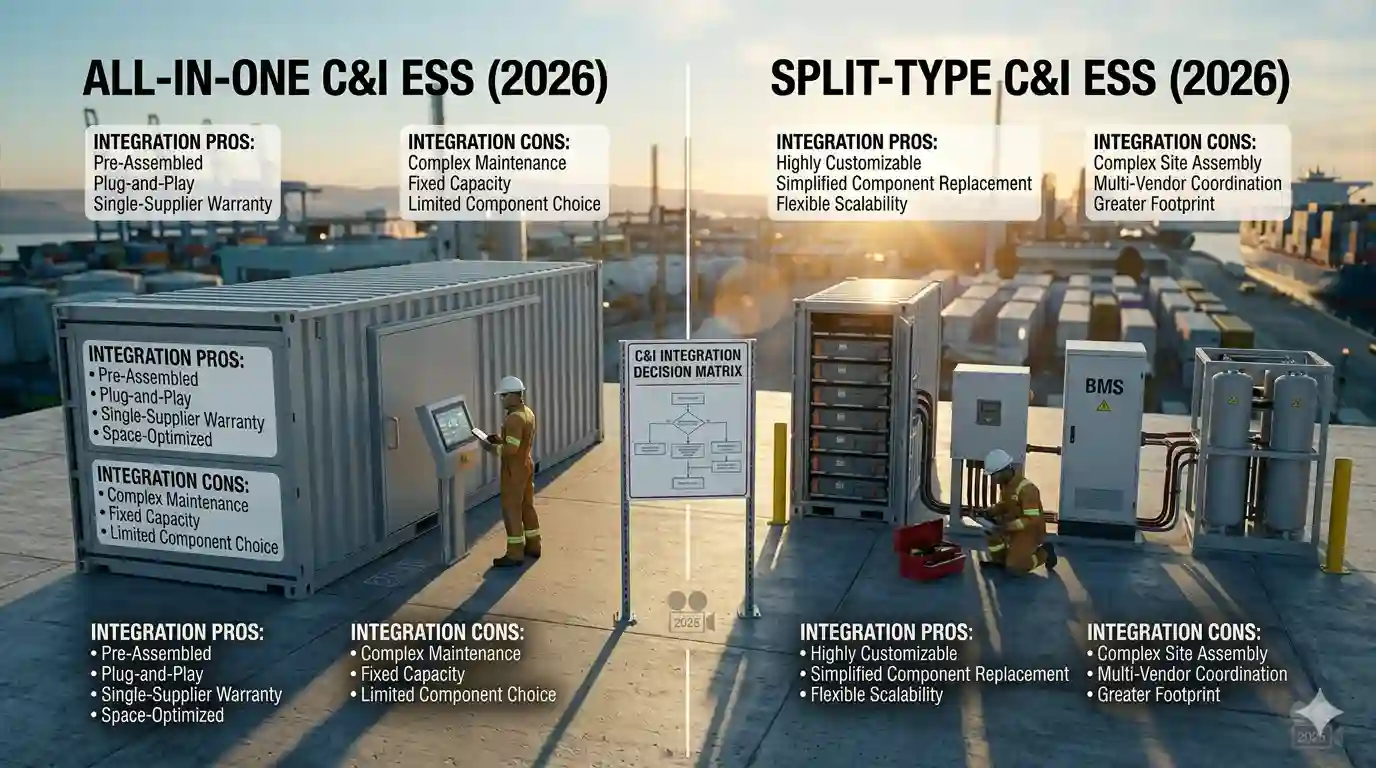
System integration architecture is a defining choice in C&I energy storage procurement. All-in-One (integrated) and Split-Type (modular) designs represent two fundamentally different approaches, each with unique strengths in installation, scalability, maintenance, and cost. Your choice directly impacts project timelines, long-term flexibility, and operational costs. This page clarifies key differences, pitfalls, and ideal applications. For complete procurement guidance, visit our comprehensive guide:
| Factor | All-in-One (Integrated) System | Split-Type (Modular) System |
|---|---|---|
| Design | Battery, PCS, BMS, thermal management in a single cabinet | Separate battery racks, PCS, EMS, thermal systems; connected via field wiring |
| Installation | Fast: Pre-configured, “plug-and-play”; 30–50% faster on-site setup | Slow: Extensive field wiring, multi-component commissioning; skilled labor required |
| Scalability | Limited: Fixed capacity/power; no expansion without full replacement | Excellent: Add battery modules or PCS units incrementally; flexible power/capacity ratios |
| Maintenance | Difficult: Single point of failure; full shutdown for repairs | Easy: Isolate faulty modules; independent servicing; minimal downtime |
| Footprint | Compact: Optimized space; ideal for small sites | Larger: Separate components need dedicated zones; better for large facilities |
| Best For | Small/medium (≤200kWh), quick-deploy, fixed-load sites | Large (≥500kWh), industrial, long-term, expandable projects |
All-in-One vs. Split Energy Storage: Installation & Cost Comparison
and
Modular Split-Type Storage: Flexibility for Industrial Energy Management.