Address
Future Science Park, Nanhu, Hangzhou
Open Hours
Workday: 7AM - 7PM
Holiday: 10AM - 5PM
Address
Future Science Park, Nanhu, Hangzhou
Open Hours
Workday: 7AM - 7PM
Holiday: 10AM - 5PM

Learn how to quantify industrial downtime savings with APEXUL’s Solar-Storage-Generator Microgrid, including the cost of a 10-minute outage and ROI core metrics.
 Byeditor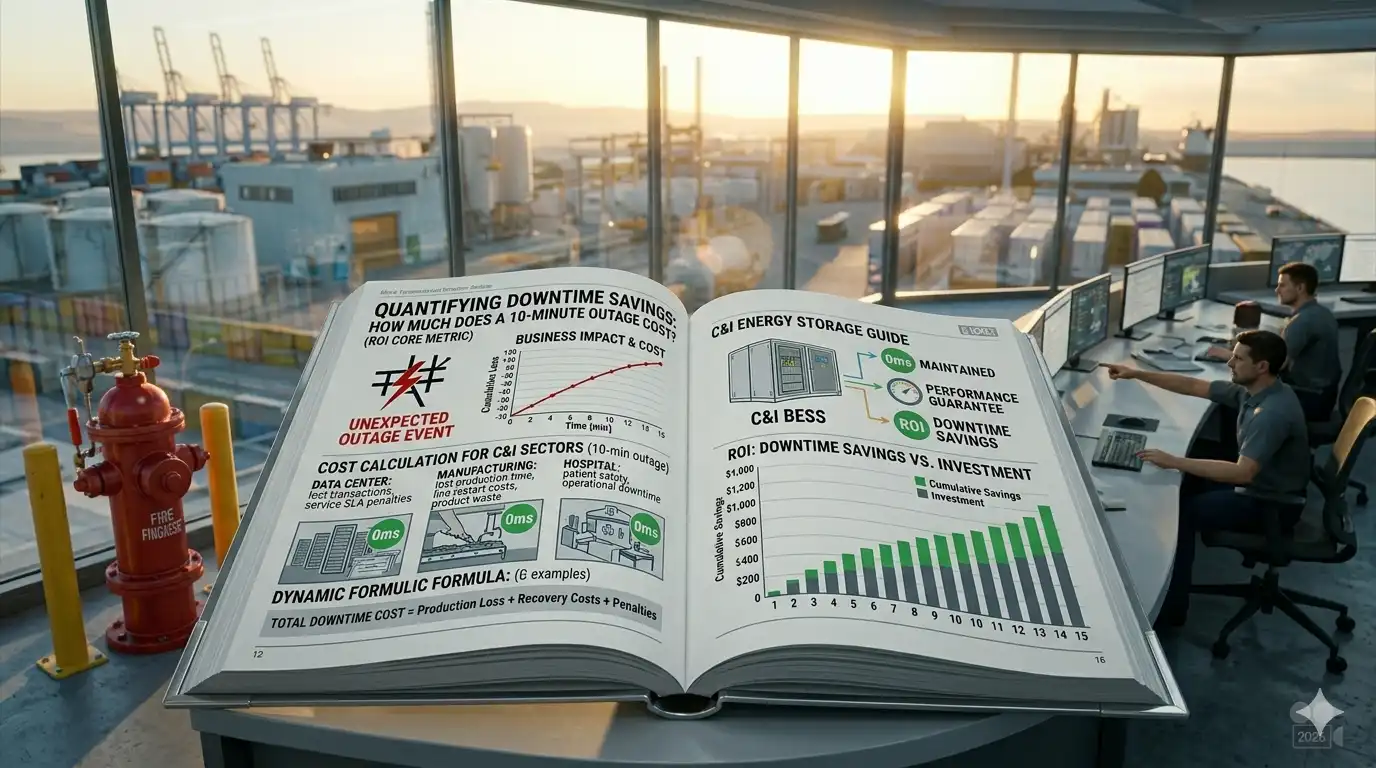
For industrial facilities, downtime is expensive—but many businesses underestimate just how costly even a short outage can be. A 10-minute unexpected power failure can cost thousands, even hundreds of thousands, of dollars, depending on the industry. Quantifying downtime savings is the core metric for calculating the ROI of APEXUL’s Solar-Storage-Generator Microgrid—and it’s critical for justifying the investment in Industrial Power Assurance and 0ms Downtime. In this guide, we break down how to calculate the cost of a 10-minute outage, how APEXUL’s system saves you money, and how to use downtime savings to build a strong ROI case for BESSBESS (Battery Energy Storage System) is a sophisticated technology that captures for Factories and Weak Grid Energy Solutions.
Investing in a Solar-Storage-Generator Microgrid requires upfront capital—but the savings from avoiding downtime often offset this cost within 1–3 years. However, to build a compelling business case, you need to quantify these savings accurately. Downtime costs include: Lost production revenue (the highest cost for manufacturing facilities).Equipment damage and repair costs (e.g., CNC machine recalibration, server replacement).Wasted raw materials (e.g., spoiled food, damaged components).Labor costs (employees paid to wait for power to be restored).Regulatory fines (for industries like healthcare or food processing that must maintain continuous operations).Reputational damage (losing customers due to missed deadlines or quality issues). By quantifying these costs, you can show exactly how much APEXUL’s Downtime capability saves your business each year—making the ROI of BESSBESS (Battery Energy Storage System) is a sophisticated technology that captures for Factories and microgrid systems clear to stakeholders.
The cost of a 10-minute outage varies by industry, but the formula is consistent: 10-Minute Outage Cost = (Hourly Operational Cost ÷ 6) × Downtime Impact Factor. Hourly Operational Cost: Total cost of running your facility per hour (including labor, raw materials, energy, and overhead).Downtime Impact Factor: A multiplier (1.2–2.0) that accounts for additional costs like equipment damage, wasted materials, and fines (higher for critical industries like healthcare or data centers). Here are real-world examples for common industries, tailored to BESSBESS (Battery Energy Storage System) is a sophisticated technology that captures for Factories and critical facilities: Precision Manufacturing: Hourly operational cost = $60,000. Impact factor = 1.5. 10-Minute Outage Cost = ($60,000 ÷ 6) × 1.5 = $15,000.Data Center: Hourly operational cost = $120,000. Impact factor = 1.8. 10-Minute Outage Cost = ($120,000 ÷ 6) × 1.8 = $36,000.Food Processing: Hourly operational cost = $40,000. Impact factor = 1.6. 10-Minute Outage Cost = ($40,000 ÷ 6) × 1.6 ≈ $10,667.Hospital: Hourly operational cost = $80,000. Impact factor = 2.0. 10-Minute Outage Cost = ($80,000 ÷ 6) × 2.0 ≈ $26,667.For facilities in Weak Grid Energy Solutions areas, which experience 10–20 outages per year, these costs add up quickly—easily reaching $100,000–$500,000 annually.
APEXUL’s Solar-Storage-Generator Microgrid eliminates downtime with 0ms Downtime switching, directly reducing or eliminating the costs outlined above. Here’s how the savings break down: 100% Downtime Elimination: The system’s 0ms switching ensures no unplanned downtime, saving you the full cost of each outage. For a precision manufacturing plant with 15 annual 10-minute outages, this equals $225,000 in annual savings. Reduced Equipment Damage: 0ms switching prevents voltage fluctuations and interruptions that damage sensitive equipment, reducing repair and replacement costs by 30–50%.Waste Reduction: For food processing or manufacturing facilities, no downtime means no wasted raw materials—saving an additional 5–10% of annual material costs.Fine Avoidance: For regulated industries, 0ms Downtime ensures compliance, avoiding fines that can cost $10,000–$100,000 per violation.ROI Calculation Example: Precision Manufacturing Plant. Let’s calculate the ROI for a precision manufacturing plant in a Weak Grid Energy Solutions area, using downtime savings as the core metric: Microgrid Investment: $500,000 (including BESSBESS (Battery Energy Storage System) is a sophisticated technology that captures for Factories, solar panels, diesel generator, and installation). Annual Downtime Savings: 15 outages × $15,000 per 10-minute outage = $225,000.Additional Savings (equipment repair + waste reduction): $75,000.Total Annual Savings: $300,000.ROI Period: $500,000 ÷ $300,000 ≈ 1.7 years (20 months). This example shows how downtime savings alone can make the microgrid investment profitable in less than 2 years—before even accounting for savings from Diesel Generator Optimization and reduced grid energy costs.
APEXULApex Ultimate is a global energy solution provider specializing in BESS, Hybrid provides a free Downtime Savings Calculator to help you quantify your unique savings. The calculator uses your industry, operational costs, and outage frequency to generate a customized report, including: Cost of a 10-minute, 1-hour, and 1-day outage. Annual downtime savings with APEXUL’s microgrid.ROI period and total lifetime savings.Conclusion: Quantifying downtime savings is the core of calculating the ROI of APEXUL’s Solar-Storage-Generator Microgrid. A 10-minute outage can cost $10,000–$36,000 or more, depending on your industry—and for facilities in Weak Grid Energy Solutions areas, these costs add up quickly. APEXUL’s 0ms Downtime capability eliminates unplanned downtime, delivering significant annual savings that offset the upfront investment in 1–3 years. For BESSBESS (Battery Energy Storage System) is a sophisticated technology that captures for Factories and critical facilities, this downtime savings is the most compelling reason to invest in reliable Industrial Power Assurance.
Return to the main guide: Ultimate Guide to Industrial Power Assurance: 0ms Downtime | APEXUL