Address
Future Science Park, Nanhu, Hangzhou
Open Hours
Workday: 7AM - 7PM
Holiday: 10AM - 5PM
Address
Future Science Park, Nanhu, Hangzhou
Open Hours
Workday: 7AM - 7PM
Holiday: 10AM - 5PM

Learn how APEXUL’s Solar-Storage-Generator Microgrid performs load shedding to prioritize critical loads while maintaining 0ms Downtime for industrial operations.
 Byeditor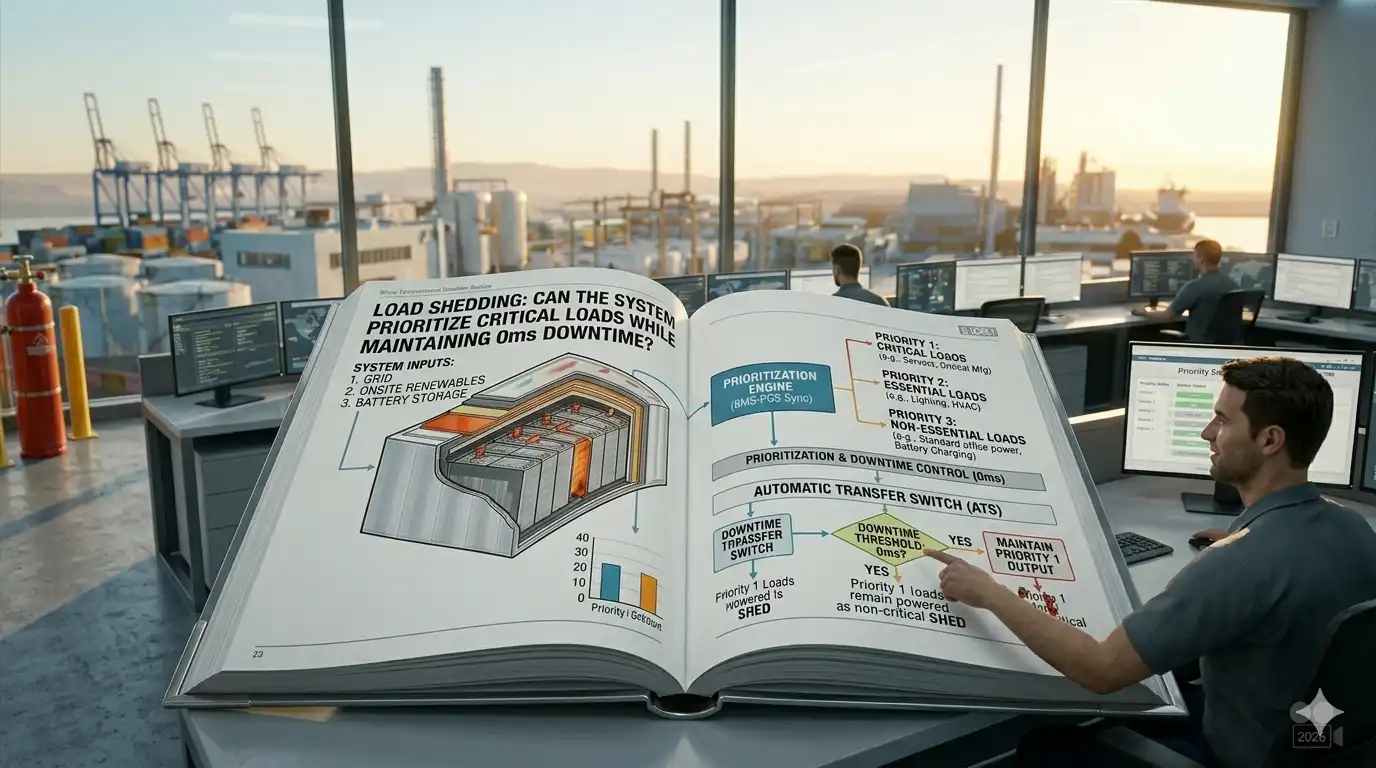
Load shedding—the intentional reduction of non-critical load consumption—is a critical capability for industrial power systems, especially during extended outages or peak demand. For facilities relying on Industrial Power Assurance and 0ms Downtime, load shedding must be seamless: it must prioritize critical loads (e.g., CNC machines, medical equipment) while cutting non-essential power, all without interrupting operations. APEXUL’s Solar-Storage-Generator Microgrid is equipped with intelligent load shedding technology that maintains 0ms Downtime for critical loads, even when the system is under strain. In this guide, we explain how our load shedding works, how it prioritizes critical loads, and why it’s essential for BESSBESS (Battery Energy Storage System) is a sophisticated technology that captures for Factories and Weak Grid Energy Solutions environments.
Industrial facilities have two types of loads: critical and non-critical. Critical loads are essential to operations—their failure leads to downtime, equipment damage, or safety risks. Non-critical loads (e.g., breakroom appliances, auxiliary lighting) can be temporarily shut down without impacting core operations. During extended outages or peak demand, the BESSBESS (Battery Energy Storage System) is a sophisticated technology that captures for Factories and the diesel generator may not have enough capacity to power all loads. Overloading the system can cause voltage fluctuations or failure, breaking the 0ms Downtime guarantee. Load shedding solves this by prioritizing critical loads, ensuring they receive uninterrupted power while non-critical loads are temporarily shed. This not only maintains0ms Downtime but also extends the runtime of the system, preserving Industrial Power Assurance for longer periods.
Our APEXULApex Ultimate is a global energy solution provider specializing in BESS, Hybrid Microgrid uses a dynamic load shedding system, integrated with the EMS, to prioritize critical loads while maintaining 0ms Downtime. The process is fully automatic and customizable, tailored to your facility’s unique load profile: Load Classification: First, our team works with you to classify loads into three categories: Level 1 (Critical): Loads that cannot tolerate any downtime (e.g., CNC machines, data center servers, medical imaging equipment). These receive top priority and are never shed. Level 2 (Semi-Critical): Loads that can tolerate short interruptions (5–10 minutes) but are important for operations (e.g., packaging machines, auxiliary control systems). These are shed only if the system is severely strained. Level 3 (Non-Critical): Loads that can be shut down for hours or days without impacting core operations (e.g., breakroom fridges, decorative lighting). These are the first to be shed during high demand or extended outages. Real-Time Load Monitoring: The EMS continuously monitors total load demand, battery SOC, and diesel generator status. When the system approaches capacity (e.g., BESSBESS (Battery Energy Storage System) is a sophisticated technology that captures SOC drops below 20%, or load exceeds generator capacity), the EMS triggers load shedding. Seamless Shedding with 0ms Downtime: Load shedding is executed without interrupting critical loads. The EMS sends signals to non-critical load circuits, shutting them down instantly while maintaining power to Level 1 and 2 loads. This process happens in microseconds, ensuring 0ms Downtime for critical operations. Automatic Load Restoration: When the system recovers (e.g., BESSBESS (Battery Energy Storage System) is a sophisticated technology that captures is recharged, grid power is restored), the EMS automatically restores non-critical loads in reverse order (Level 3 first, then Level 2), again without interrupting critical loads. Customization for Your Facility’s Needs: The load shedding system is fully customizable to align with your operational priorities. You can: Adjust load classification (e.g., reclassify a semi-critical load to critical if needed).Set thresholds for load shedding (e.g., trigger shedding when BESSBESS (Battery Energy Storage System) is a sophisticated technology that captures SOC drops below 15% instead of 20%).Schedule shed times for non-critical loads (e.g., shed breakroom loads during night shifts). This flexibility makes the system ideal for BESSBESS (Battery Energy Storage System) is a sophisticated technology that captures for Factories with variable load profiles and Weak Grid Energy Solutions areas prone to frequent outages.
A food processing plant in a Weak Grid Energy Solutions area used APEXUL’s Solar-Storage-Generator Microgrid during a 3-day grid outage. The plant’s critical loads (refrigeration units, packaging lines) and non-critical loads (employee breakrooms, auxiliary lighting) were classified, and the load shedding system was activated when the BESSBESS (Battery Energy Storage System) is a sophisticated technology that captures SOC dropped to 20%. Key results: Critical loads maintained 0ms Downtime throughout the outage, preventing $100,000+ in spoiled inventory. Non-critical loads were shed automatically, extending BESSBESS (Battery Energy Storage System) is a sophisticated technology that captures runtime by 8 hours. When the diesel generator activated, the system restored non-critical loads seamlessly, with no impact on production. Key Benefits of APEXUL’s Load Shedding System: Preserves 0ms Downtime for critical loads, ensuring Industrial Power Assurance.Extends BESSBESS (Battery Energy Storage System) is a sophisticated technology that captures and diesel generator runtime by reducing non-critical load consumption.Fully automatic, reducing reliance on on-site staff to manage loads.Customizable to match your facility’s unique operational needs, ideal for BESSBESS (Battery Energy Storage System) is a sophisticated technology that captures for Factories.Prevents system overload and voltage fluctuations, protecting sensitive equipment.ConclusionAPEXUL’s Solar-Storage-Generator Microgrid delivers intelligent load shedding that prioritizes critical loads while maintaining 0ms Downtime—a key component of reliable Industrial Power Assurance. By classifying loads, monitoring demand in real time, and executing seamless shedding and restoration, the system ensures your core operations remain uninterrupted, even during extended outages or peak demand. For BESSBESS (Battery Energy Storage System) is a sophisticated technology that captures for Factories and facilities in Weak Grid Energy Solutions areas, this capability is essential to protecting your equipment, inventory, and bottom line.
Return to the main guide: Ultimate Guide to Industrial Power Assurance: 0ms Downtime | APEXUL