For commercial and industrial (C&I) energy storage procurement, thermal runaway and fire safety compliance are non-negotiable priorities. A single thermal runaway incident can cause catastrophic fires, production downtime, property loss, and even legal liability—risks that far outweigh short-term cost savings from cutting corners on safety. This support page breaks down key pitfalls, global compliance standards, and actionable solutions to ensure your energy storage system meets the highest safety requirements. For detailed insights on thermal runaway testing standards, refer to GB/T 44026-2024 Thermal Runaway Protection Standards (English Version). For an overview of all C&I energy storage procurement considerations, please visit: The Ultimate Guide to Avoiding Pitfalls in Commercial & Industrial Energy Storage Procurement: 15 Critical Questions & Solutions (2026 Edition).
Key Pitfalls in Thermal Runaway & Fire Safety Procurement
- Misunderstanding Thermal Runaway Triggers: Many buyers overlook common causes—overcharging, internal cell defects, inadequate thermal management, or mechanical damage—which can trigger uncontrolled temperature rises and chemical decomposition in lithium-ion batteries.
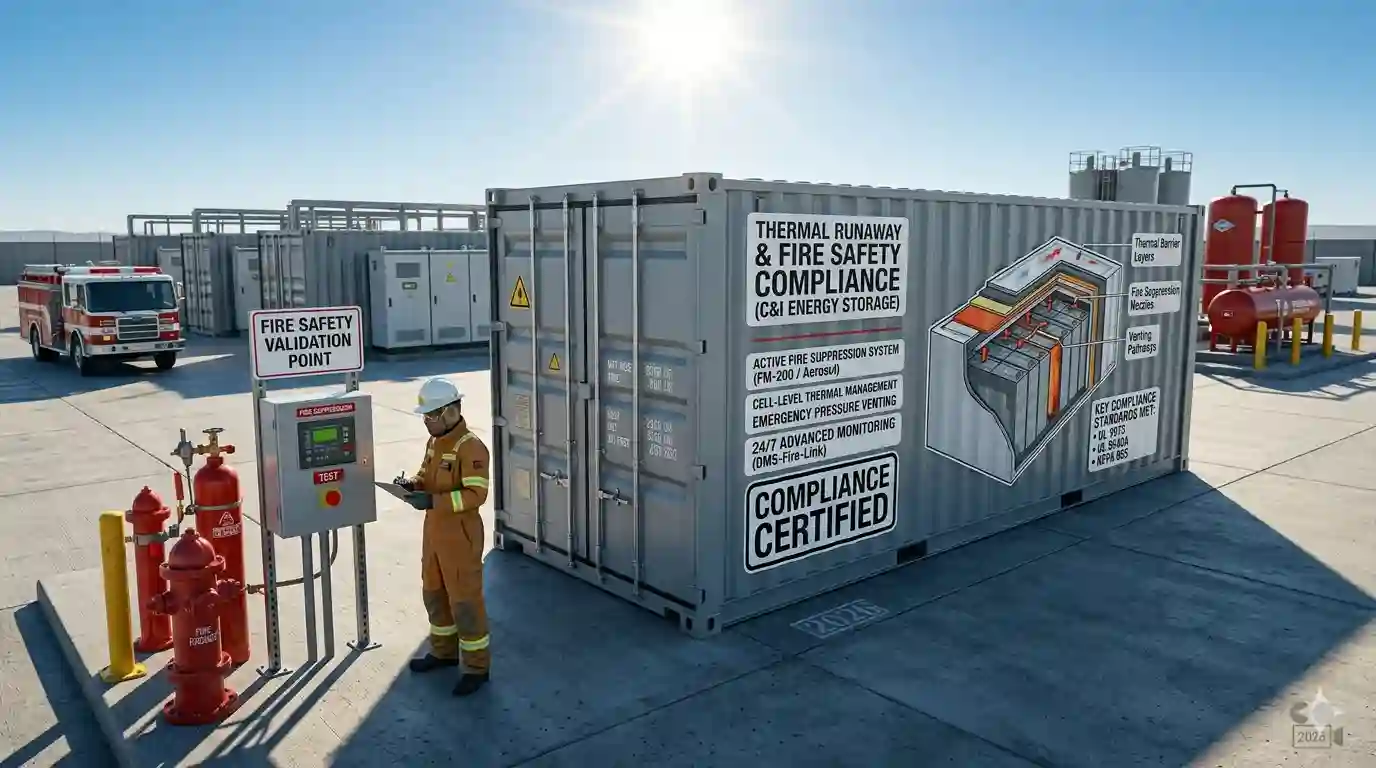
- Ignoring Regional Compliance Standards: Different regions have strict mandates (e.g., NFPA 855 in the US, IEC 62933 in the EU, UL 9540A globally) that dictate fire safety requirements, and non-compliance can lead to project shutdowns or fines. Explore global fire safety standards for energy storage at The Latest Fire Protection Standards for Energy Storage.
- Opting for Inferior Fire Suppression: Cheap, generic fire suppression systems (e.g., water-based) are ineffective for lithium-ion battery fires, which require clean-agent solutions to prevent re-ignition and toxic gas release.
- Neglecting Early Warning Systems: Failing to integrate multi-sensor detection (smoke, gas, temperature) means thermal runaway is detected too late to minimize damage.
Global Fire Safety Compliance Standards You Must Know
Compliance is critical for both safety and market access. Below are the core standards for C&I energy storage systems:
- UL 9540A (US): Tests battery storage systems for fire propagation, requiring “no fire, no explosion” performance under abnormal conditions, with a typical approval process of 6-8 months.
- IEC 62933 (EU): Mandatory for EU deployments, covering safety, performance, and environmental resilience, with 12+ safety tests required for CE marking.
- NFPA 855 (US): Implemented after multiple battery-related fires in 2022, requiring mandatory fire suppression and a minimum 3-foot clearance for commercial systems.
- GB/T 44026 (China): Focuses on “no fire, no explosion” requirements for lithium-ion energy storage systems, widely recognized in Asia-Pacific markets.
APEX Ultimate Solution: 5-Level Fire Safety & Thermal Runaway Prevention
We prioritize thermal runaway prevention and fire safety compliance in every C&I energy storage system, integrating advanced technologies and global standards:
- Cell-Level Protection (BMS): Our advanced Battery Management System (BMS) monitors voltage, temperature, and current in real time, with millisecond-level response to detect abnormal cell behavior—preventing overcharging and internal short circuits that trigger thermal runaway.
- Thermal Management: Liquid cooling systems maintain ±2°C temperature uniformity across cells, eliminating hotspots and slowing degradation—critical for preventing thermal runaway in high-density C&I systems.
- Structural Isolation: Fire-resistant compartments and thermal barriers between battery modules contain potential thermal runaway incidents, preventing spread to the entire system.
- Early Warning Detection: Multi-sensor systems (smoke, CO/H2 gas, temperature) provide real-time alerts, allowing preemptive action before thermal runaway occurs.
- Clean-Agent Fire Suppression: Automatic, module-level fire suppression using FK-5-1-12 (Novec 1230) quickly extinguishes fires without damaging equipment or releasing toxic fumes, ensuring compliance with global standards.
Procurement Checklist for Thermal Runaway & Fire Safety
- Verify the system meets UL 9540A, IEC 62933, or regional equivalent standards.
- Confirm the fire suppression system uses clean agents (not water-based) and is module-level.
- Check for real-time BMS monitoring and early warning sensors.
- Request test reports for thermal runaway containment and fire suppression effectiveness.

 Byeditor