Address
Future Science Park, Nanhu, Hangzhou
Open Hours
Workday: 7AM - 7PM
Holiday: 10AM - 5PM
Address
Future Science Park, Nanhu, Hangzhou
Open Hours
Workday: 7AM - 7PM
Holiday: 10AM - 5PM

Phnom Penh power outage solution: self-healing vs manual. Apex's grid-forming PV-storage-diesel ensures millisecond protection & reliability advantage.
 Byeditor
Table of Contents
At 2 a.m., a lightning strike triggered a fault in a fine chemical park. In the traditional model, operators had to search for the fault in the dark and attempt restoration section by section. Manual restoration took over 2 hours—production lines had long since solidified, and materials were scrapped. In another park equipped with a fully automatic self-healing system, the system isolated the fault and restored power to non-fault sections within 320 milliseconds of the fault occurring. The lights in the production workshop merely “blinked.” The chasm between this millisecond-level restoration and hour-long emergency repairs represents the defining divide in power quality for modern industry and commerce. This article delves into the evolution of distribution network self-healing technologies, compares the actual performance differences between manual restoration, minute-level self-healing, and millisecond-level restoration, and reveals how black start capability and fully automatic 100% self-healing fundamentally solve the core challenge of “how to avoid short-term power outages.”
For modern manufacturing, losses from a short-term power outage often far exceed those from a prolonged planned outage.
1. Millisecond Interruptions, Hour-Long Recoveries
Process industries such as chemicals, semiconductors, and precision manufacturing have extremely high demands for power supply continuity. A single voltage sag or short-term power outage, even lasting just tens of milliseconds, can cause:
More critically, restarting equipment and recovering processes after a brief power outage can take hours. According to statistics from one chemical plant, a total plant shutdown caused by a single short-term power outage resulted in an average recovery time exceeding 4 hours and direct economic losses of millions of yuan.
2. The Three Major Pain Points of Traditional Manual Restoration
Facing short-term power outages, the traditional model relying on manual restoration has inherent defects:
This passive “repair after failure” model can no longer meet the stringent requirements of modern industry and commerce for power supply reliability.
The evolution of distribution network self-healing technology is essentially a process of continuously pushing restoration speed from “hour-level” towards “millisecond-level.”
| Restoration Method | Typical Technology | Restoration Time | User Experience | Application Scenario |
|---|---|---|---|---|
| Manual Restoration | Manual line inspection, sectional trial restoration | 1-4 hours | Long outage, production interruption | Distribution networks without automation |
| Minute-Level Self-Healing | Traditional Automatic Transfer Switch (ATS), Feeder Automation | 1-3 minutes | Brief outage, equipment may restart | Urban distribution networks |
| Second-Level Self-Healing | 5G distribution network self-healing, mesh protection | 0.1-1 second | Lights flicker, equipment may be unaffected | Distribution networks with high reliability requirements |
| Millisecond-Level Restoration | Grid-forming energy storage, Black Start | <100 milliseconds | Imperceptible, continuous power supply | Critical loads, microgrids |
1. Manual Restoration: The Legacy of a Passive Response Era
In distribution networks without automation, fault restoration relies entirely on manual restoration. Operators must travel to the site after receiving a report, trace the line to find the fault point, and then attempt restoration section by section. This process takes 1-2 hours, sometimes over half a day. For factories operating continuously, this torment of “waiting for power” can cause devastating losses.
2. Minute-Level Self-Healing: Limitations of Traditional Automation
Traditional ATS and feeder automation systems can automatically isolate faults and restore power to non-fault sections, typically within 1-3 minutes. However, this time window still poses a threat to precision equipment—inverters may have already shut down due to undervoltage, contactors may have dropped out, and DCS systems may have restarted. The problem of “how to avoid short-term power outages” is not truly solved.
3. Second-Level Self-Healing: Breakthroughs with 5G and Mesh Protection
In recent years, the application of 5G communication and mesh protection technologies has compressed restoration time to the second level.
In July 2025, a demonstration project by the State Grid Hunan Electric Power on a 10kV line in the Jianghua area of Yongzhou validated the powerful capability of mesh protection: after a line fault occurred, protection tripped, and the mesh protection self-healing function was immediately triggered, automatically controlling the tie switch to close, transferring the load of 85 distribution areas and 4,950 customers to an adjacent line. Restoration time was compressed to under 1 second, avoiding a 2000kW load loss.
Around the same time, the first overhead line 5G distribution network self-healing system in China was commissioned in Zhanqi Village, Pidu District, Chengdu. During a fault simulation test, fault clearance took 165 milliseconds, and the total time for automatic power restoration was less than 1 second, making the distribution network fault imperceptible to users.
The panoramic main-distribution coordination self-healing system built by State Grid Qingdao Power Supply Company went a step further, compressing the restoration time for a complete substation outage from hours to within 3 minutes, achieving “second-level perception, minute-level self-healing.”
4. Millisecond-Level Restoration and Black Start Capability: The Ultimate Form of Self-Healing Technology
The true technological breakthrough comes from the introduction of grid-forming energy storage and black start capability.
In December 2025, Hejiagou Village in Shiyan, Hubei Province, completed the province’s first black start test for a 10kV rural microgrid. Technicians simulated the most extreme scenario—after the main grid was completely de-energized, the grid-forming energy storage station started up rapidly, restoring the power supply rhythm in less than 100 milliseconds, and successfully “awakened” the connected distributed photovoltaic systems and wind turbines, forming an independently operating microgrid.
The core of this test lies in the fundamental difference between grid-forming energy storage and traditional grid-following energy storage:
It is this capability of “self-starting, self-adapting, self-operating” that makes millisecond-level restoration and black-start capability a reality, fundamentally answering the ultimate question of “how to avoid short-term power outages.”
When evaluating distribution network self-healing capability, two core indicators are particularly noteworthy.
1. Self-Healing Success Rate: The Litmus Test of Technical Reliability
The self-healing success rate refers to the proportion of faults where the self-healing system successfully isolates the fault and restores power to non-fault areas. The mesh protection system developed by State Grid Hunan Electric Power increased the overall fault handling efficiency of the distribution network by 73 percentage points. The main-distribution coordination panoramic self-healing system built by State Grid Qingdao Power Supply Company achieves fault diagnosis in just 30 seconds, automatically generates the optimal transfer strategy, and executes it with one-click sequence control.
2. Fully Automatic 100% Self-Healing: The Path to the Ultimate Goal
Fully automatic 100% self-healing means:
This is not an unattainable ideal. The black start test in Hejiagou Village validated the feasibility of fully automatic 100% self-healing under the extreme condition of complete main grid loss—from grid outage to energy storage self-start, to load pickup, to awakening PV and wind turbines—all completed automatically.
The mesh protection equipment used by State Grid Hunan Electric Power achieved a scenario where, after fault isolation, relevant protection devices “notify each other,” information is quickly transmitted to the switch responsible for restoration, which automatically closes to restore power, reducing the restoration time for non-fault sections to 1 second.
As a solution provider with 20 years of experience in global industrial and commercial energy projects, Apex UltimateApex Ultimate is a global energy solution provider specializing in BESS, Hybrid deeply understands the devastating impact of short-term power outages on manufacturing. We bring black start capability and millisecond-level restoration from grid-level technology to the industrial and commercial user side, building a dedicated power supply reliability protection system for enterprises.
1. Grid-Forming Energy Storage: The Core Engine for Millisecond-Level Restoration
Our integrated PV + Storage + Diesel system is centered on grid-forming energy storage, possessing the same level of black start capability validated in the Hejiagou Village test:
2. PV-Storage-Diesel Coordination: A Three-Level Defense Ensuring Ultimate Reliability
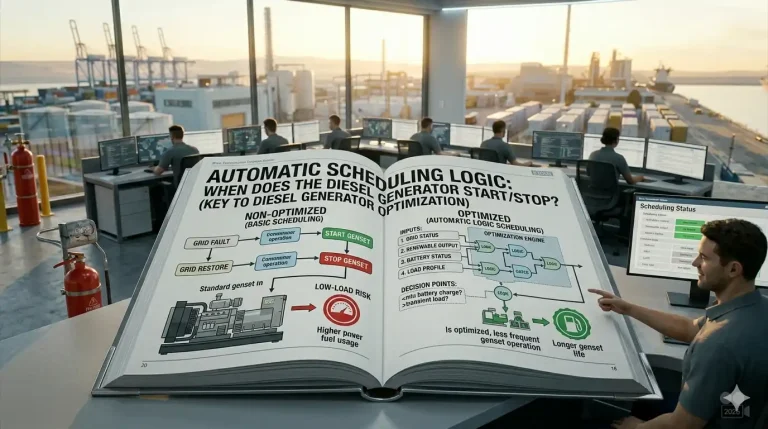
Our system builds a three-level protection system featuring “fast energy storage response, continuous PV supply, and ultimate diesel generator backup”:
| Protection Level | Response Time | Functional Role | Guaranteed Effect |
|---|---|---|---|
| Level 1: Grid-Forming Energy Storage | <20 ms | Millisecond restoration, voltage/frequency building | Continuous, imperceptible operation of critical loads |
| Level 2: PV System | Seconds | Continuous energy supply, extended backup time | PV-storage coordination for economic efficiency |
| Level 3: Diesel Generator | Minutes | Ultimate guarantee for extreme scenarios | Unlimited backup time, failsafe protection |
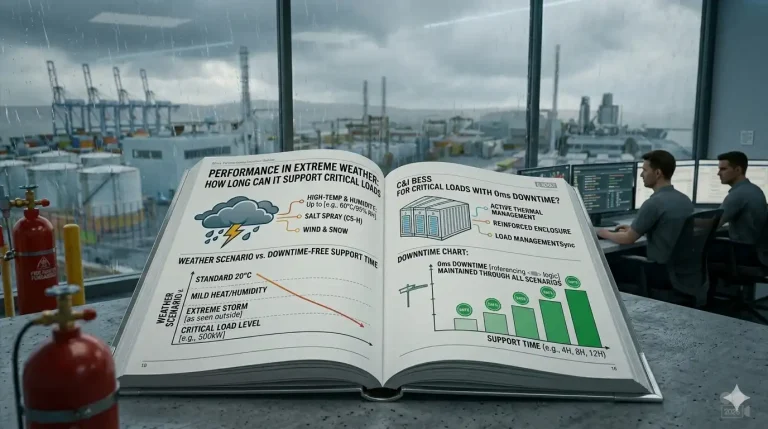
This system was validated in a project for an Iraqi camp in the Middle East: the PV-storage system successfully achieved stable, independent load operation, with the diesel generator automatically and seamlessly switching in, fully realizing the closed loop of “cost reduction, carbon reduction, and supply guarantee.”
3. From “Passive Waiting” to “Active Control”: The Economics of Self-Healing Capability
Comparing the economics of traditional manual restoration with Apex Ultimate’s millisecond-level restoration solution:
| Comparison Dimension | Traditional Manual Restoration Mode | Apex UltimateApex Ultimate is a global energy solution provider specializing in BESS, Hybrid Millisecond-Level Restoration Solution |
|---|---|---|
| Fault Restoration Time | 1-4 hours | <20 milliseconds |
| Loss per Outage | Millions of yuan (chemical industry example) | Near zero |
| Equipment Restart Cost | High (material scrap, equipment stress) | None |
| Personnel Involvement | Significant emergency manpower | Fully automatic, no manual intervention |
| Self-Healing Success Rate | Relies on manual experience | 99.9%+ |
| Investment Nature | Pure cost center | Value-creating asset |
4. Global-Local Delivery, Ensuring Solution Implementation
Leveraging our network of local EPC partners across Europe, the Middle East, Southeast Asia, Latin America, and Africa, we provide global industrial and commercial clients with:
While manual restoration still operates on an hourly timescale and traditional automation pursues minute-level self-healing, millisecond-level restoration and black-start capability have propelled power supply reliability to a new frontier.
In process industries like chemicals, semiconductors, and precision manufacturing, “how to avoid short-term power outages” is no longer just a technical issue but a strategic imperative tied to survival and competitiveness. Choosing Apex UltimateApex Ultimate is a global energy solution provider specializing in BESS, Hybrid means choosing more than just a PV-storage-diesel system; it means choosing a dedicated microgrid with fully automatic 100% self-healing capability—a system where your production lines remain rock-solid stable, regardless of external grid fluctuations.
Act Now to Build Your Millisecond-Level Restoration Defense Line:
We offer manufacturing clients:
[Click Here to Schedule a One-on-One Consultation with a Senior Power Quality Engineer]
Email: info@apexul.com